
Observing your emotions seems simple. Yet in daily life, we often miss what we’re truly feeling: we react, we move from one day to the next, without always taking the time to look at what’s going on inside.
One day, while rereading my journal, I noticed something interesting: the same triggers kept coming up again and again. An offhand remark, a comment, one word too many… and a whole inner file would open up.
That’s when I understood that emotions don’t arise by chance. They follow patterns and they have something to tell us.
In this article, I’ll show you how to identify and recognise your emotions simply, in the flow of an ordinary day.
Why observe your emotions rather than manage them
We hear a lot about managing our emotions. In fact, it’s actually one of the most common searches on the topic. Yet managing implies controlling, mastering, reducing. It’s an exhausting stance in the long run.
Observing is different. Instead, we’re not trying to change what we feel. We’re trying to see it. It’s a stance of openness, not combat.
In reality, it’s often more effective. Research in psychology shows that simply naming an emotion already reduces its intensity. This is what researchers call affect labeling, emotional labeling: naming an emotion activates the region of the brain that regulates emotional reactions (Lieberman et al., 2007, UCLA). In other words, observing is not passive. It’s already taking action.
So, before wanting to manage anything, this practice is the first step, and often the most useful one.
What does it really mean to observe your emotions?
It’s not about spending hours doing introspection. Nor is it about asking yourself “why do I feel this?” at every moment.
Instead, the process is much simpler. It’s about noticing.
For instance, you might notice a moment of tension. Maybe there’s an urge to avoid a conversation. Sometimes, something touches you more than you expected.
In fact, we’re not trying to understand right away. Analysis comes later. Observation, on the other hand, takes only a few seconds, anywhere: on the subway, between two meetings, in the evening before going to sleep.
It’s also recognising your emotions without judging them, for example, because an emotion is neither good nor bad. It’s information. Not a verdict.
How to observe your emotions daily in 1 minute
No need for a complex ritual. Here’s a concrete method, tested in daily life.
The 3-question check-in:
1. What am I feeling right now? (one word is enough)
2. Where do I feel it in my body?
3. Since when?
That’s it. No judgment, no analysis. Just three honest answers. This method works in the morning on the subway or over breakfast, or in the evening before opening your journal.
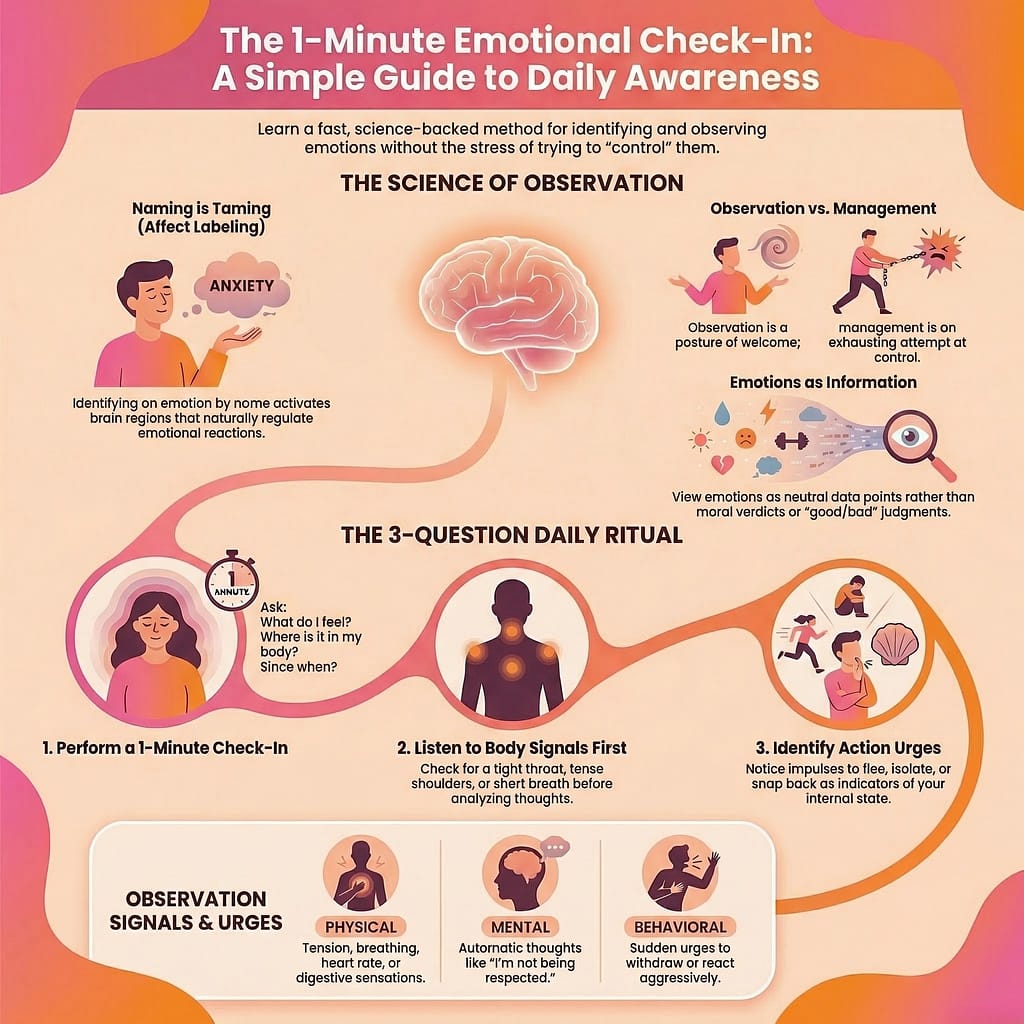
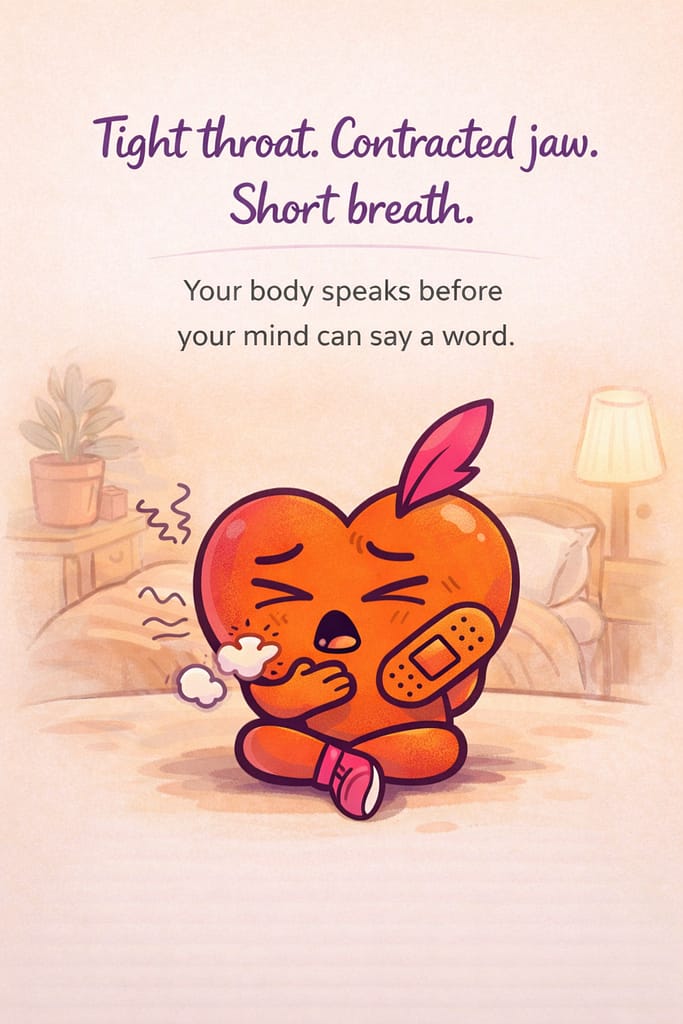
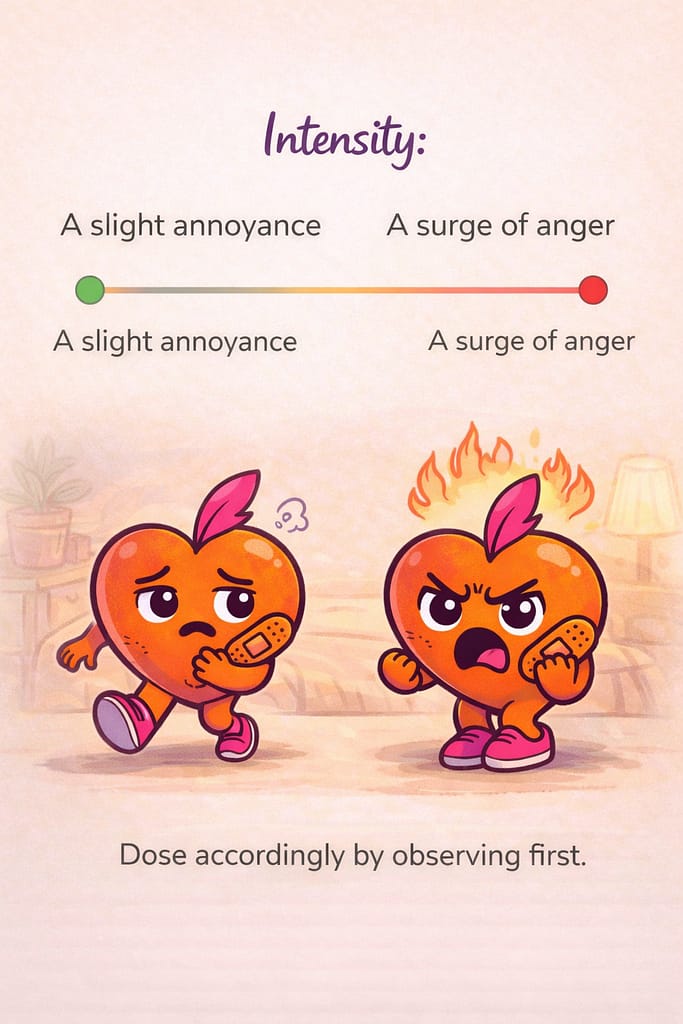
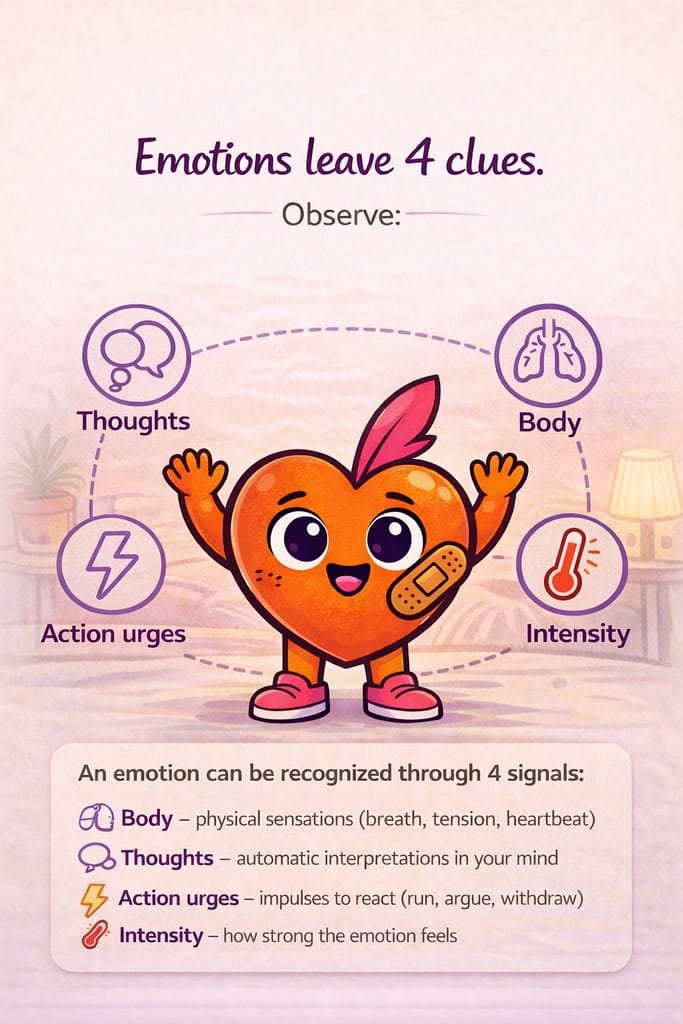
When you don’t know what you’re feeling, the best approach is to start with the body. Before the brain can formulate anything, the body has already reacted. A tight throat, contracted shoulders, slightly short breath: these physical signals are often the first trace of an emotion.
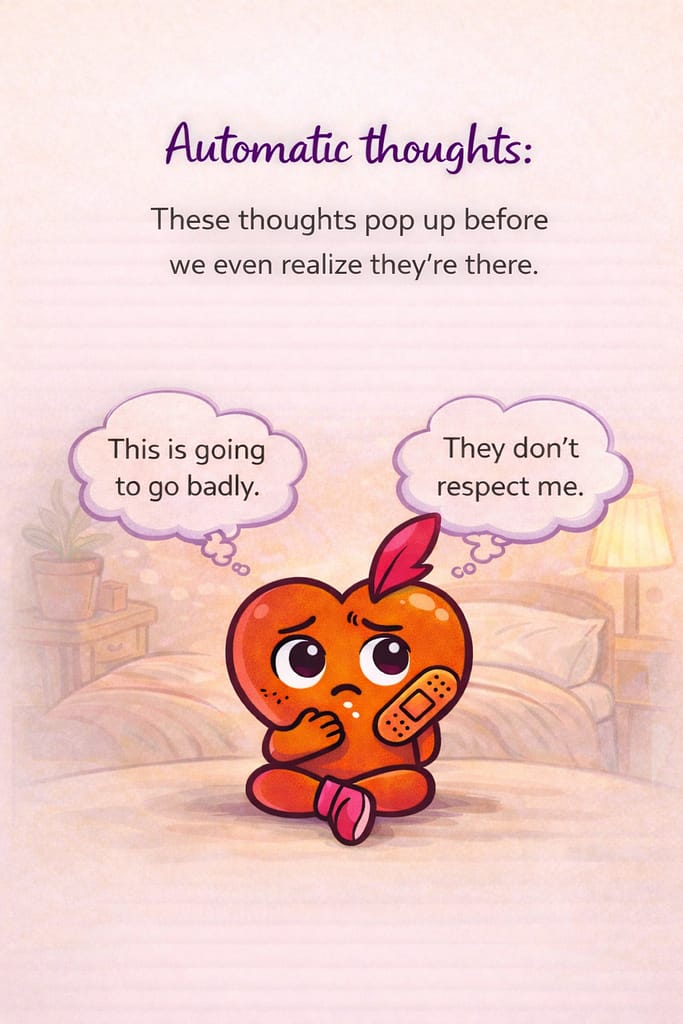
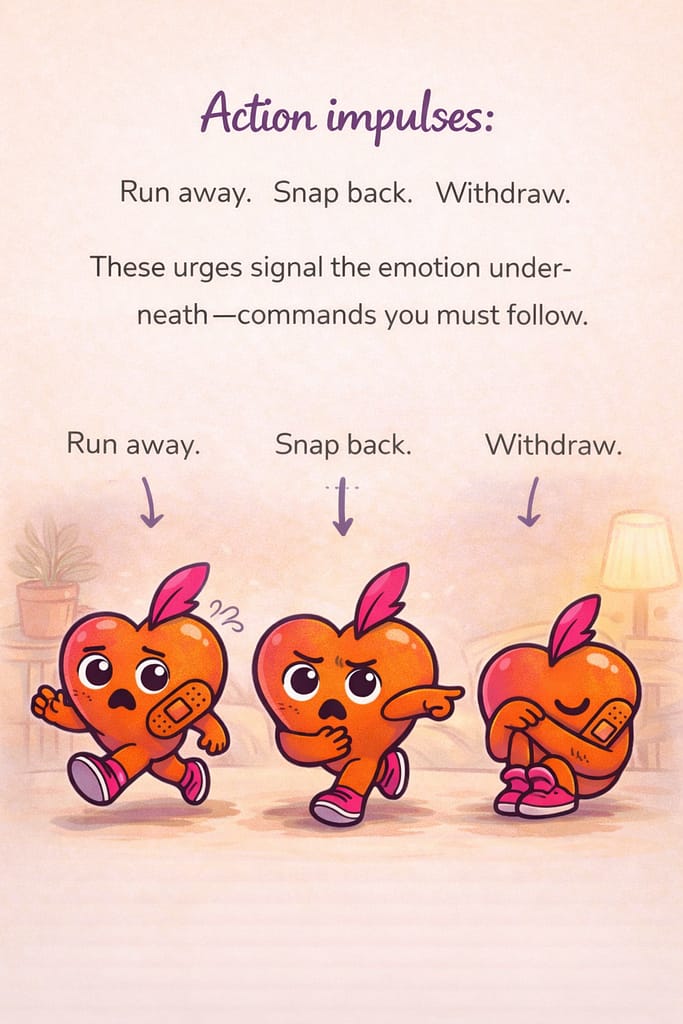
Then there are automatic thoughts. “This is going to go badly.” “They don’t respect me.” These inner phrases indicate what’s happening emotionally. Also look at your action urges: fleeing, responding sharply, withdrawing. These are not orders to follow; they’re indicators.
Over time, with regularity, these micro-observations accumulate. You begin to see patterns. Certain situations keep coming up. That’s when this daily practice becomes truly useful.


What’s really stopping you from observing your emotions daily
First, time. “I don’t have time to stop and think about what I’m feeling.” In reality, 1 minute a day is enough. The problem isn’t time; it’s habit.
There’s also the fear of what you’ll find. Stopping to look at your inner experience can bring up things you’d rather not see. Yet what you don’t observe doesn’t disappear. It stays there, in the background, and resurfaces in other ways.
It’s also worth saying that a common misconception holds many people back: this practice is supposedly reserved for very sensitive or very introspective people. That’s not true. It’s a skill, like any other. It can be learned, practised and improved.
Last barrier: the fear of over-interpreting. Observing is not analysing excessively. It’s simply welcoming what’s there, without clinging to it. Neither denying nor dissecting.
Observing your emotions daily: where to start tomorrow
Becoming aware of your emotions is not about becoming perfect. Nor about always being calm, positive or balanced.
It’s simply about being a little less surprised by yourself. Reacting with a little more perspective. Understanding, over time, what truly matters to you.
So it’s not a huge undertaking. It’s 1 minute a day, consistency, and curiosity about yourself.
If you want a simple place to note what you feel each day and track your emotions over time, that’s exactly what the emotional motivation app Emosupport offers. Join the Emosupporters and note your first bubble of the day by trying the app. No pressure. Just to see.
And you? Do you already observe your emotions? What emotion can’t you quite name yet? You’re probably not alone in feeling the same thing. Tell me more in the comments.
In my next article, I’ll be talking about the difference between emotion and mood, so you don’t mix them up.
FAQ: observing your emotions daily
It means paying attention to what you feel without trying to change or judge it. It means noticing a tension, an unease, a lightness, without necessarily looking for an immediate explanation. Observation comes before understanding.
Managing your emotions means trying to control them. Taking the time to observe them means first welcoming them. In reality, you can’t manage well what you haven’t first recognised. Observation is the first step; management, if necessary, comes after.
The 4 pillars are: identifying your emotions, understanding their origin, regulating them and using them constructively. Observing your emotions daily means working directly on the first pillar. To go further on the difference between emotional intelligence and motivation, check out this article named : Emotional Intelligence & Emotional Motivation: It’S Not The Same Thing.
Often, the emotions of the day haven’t been observed in the moment. They accumulate and resurface when the pace slows down. Moreover, fatigue lowers our tolerance threshold. There’s also a direct link between emotions and sleep quality: stress, anxiety and night wake-ups are often more connected than we think.
Start with the body: where you physically sense something. Then look for a simple word, even an imprecise one. “Discomfort”, “tension”, “fog”. A vague word is better than nothing. With practice, emotional vocabulary grows naturally.