
In the evening, when the day’s distractions fade away, the brain finds itself alone with everything it has accumulated. Unresolved worries, lingering tensions, worst-case scenarios — all of it comes back up at exactly the moment you need to let go.
Stress keeps you in alert mode… This isn’t a weakness. It’s your brain staying on guard. Your body remains in vigilance mode when it should be shifting into rest. The result: trouble falling asleep, broken sleep, night-time wake-ups — often at the same time, with the same thoughts rushing back through your head.
This isn’t a weakness. It’s your nervous system doing its job — poorly calibrated, but diligently.
Sleep and emotions: why your brain switches on at night.
In the evening, when the day’s distractions fade away, the brain finds itself alone with everything it has accumulated. Unresolved worries, lingering tensions, worst-case scenarios — all of it comes back up at exactly the moment you need to let go.
Stress keeps you in alert mode… This isn’t a weakness. It’s your brain staying on guard. Your body remains in vigilance mode when it should be shifting into rest. The result: trouble falling asleep, broken sleep, night-time wake-ups — often at the same time, with the same thoughts rushing back through your head.
This isn’t a weakness. It’s your nervous system doing its job — poorly calibrated, but diligently.

The vicious cycle: bad night, stronger emotions.
Poor sleep makes you emotionally vulnerable.
A tired brain is much worse at regulating emotions. The smallest friction becomes a mountain. Irritability sets in. Sadness slides in more easily. The ability to put things in perspective disappears.
What many people don’t realize: this isn’t “being oversensitive.” It’s sleep deprivation. That distinction matters, because it completely changes how you talk to yourself the next morning.
Heavy emotions → bad night → difficult next day → more emotions to manage → even less sleep.
Once this vicious cycle is in place, it’s hard to break all at once. Your chamomile tea or guided meditation playlist — sometimes it helps. Often, it’s not enough — because the root cause is emotional, not just physical.
What actually helps is understanding what’s happening first. Observing your nights, identifying patterns, seeing the connections. That’s exactly where Emosupport comes in.
Why Emosupport tracks your sleep
Emosupport is not a medical app. It doesn’t diagnose anything, prescribe anything, or replace any healthcare professional.
As an emotional motivation app, what it does is give you a simple, judgment-free observation tool. Each day, you log your mood, your energy and your dominant emotions. Each morning, you note how you slept — duration, how rested you felt, and how you woke up.
Over time, patterns emerge. The nights that follow stressful days. The recurring wake-ups linked to certain emotions. This helps you step back from those emotions and welcome them with kindness.
And when you go see your doctor or a specialist, you’ll arrive with concrete data — not vague impressions. That’s a completely different kind of conversation.
A few practical things to help you fall back asleep at 2am
Stay in the dark, avoid screens
Not just because of blue light — because of the emotional stimulation they create. Don’t turn the TV back on. Late-night news, social media: all of that feeds exactly the thoughts you don’t need at 2am, or at bedtime for that matter.
Create a wind-down ritual
Get up and write 3 things — your choice, on a piece of paper:
- what’s going round in circles in your head (to get it out)
- what you’ll do tomorrow (so you can stop thinking about it right now)
- or 3 things that are going well and that you’re grateful for
The goal is to tell your brain: “ok, noted, we’ll deal with it later.” You write down what you’re putting aside before turning off the light. The brain learns that action mode is over.
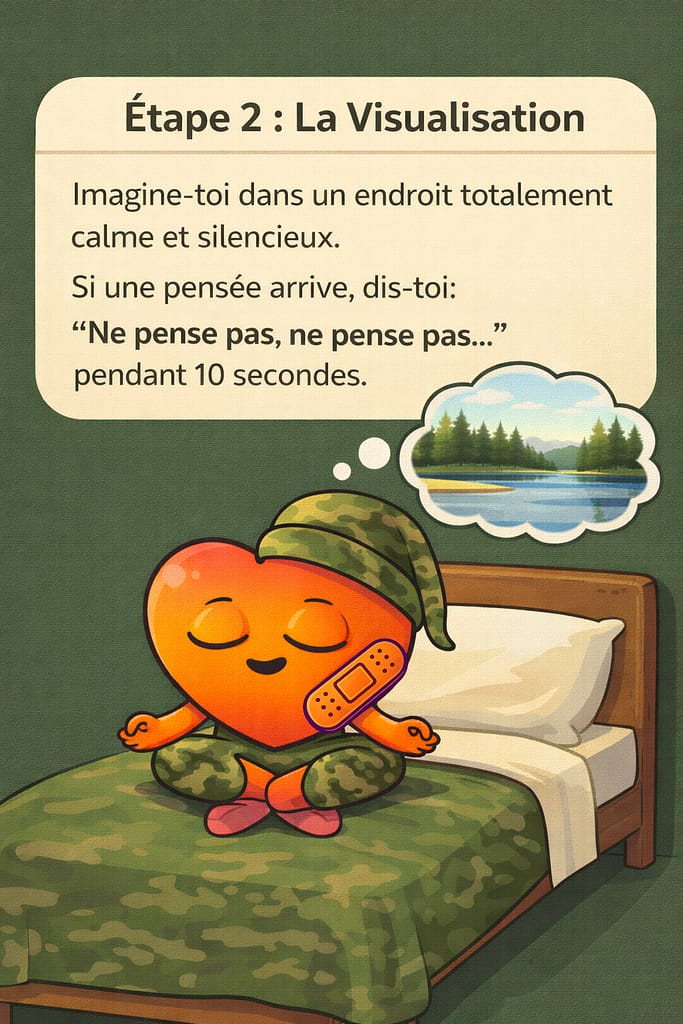
Use visualization
Rather than fighting negative thoughts — which only makes them stronger — replace them with positive ones. Think about your next holiday or a project you’re excited about. Picture it in detail as if you can see it right in front of you, and feel the happiness it brings you. The brain can’t hold two trains of thought at the same time.
Try a guided meditation
Five minutes, no more. The goal isn’t to empty your mind — it’s to signal to it that action mode is over. Apps like Petit Bambou offer specific guided sessions for the evening.
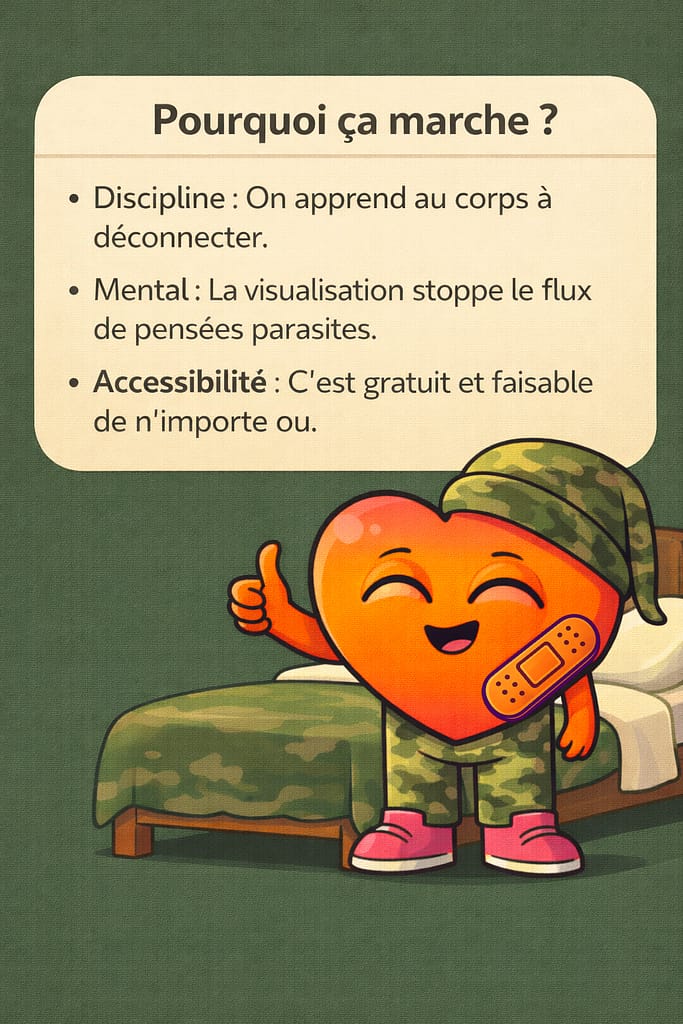
Fall asleep in one minute with the military method
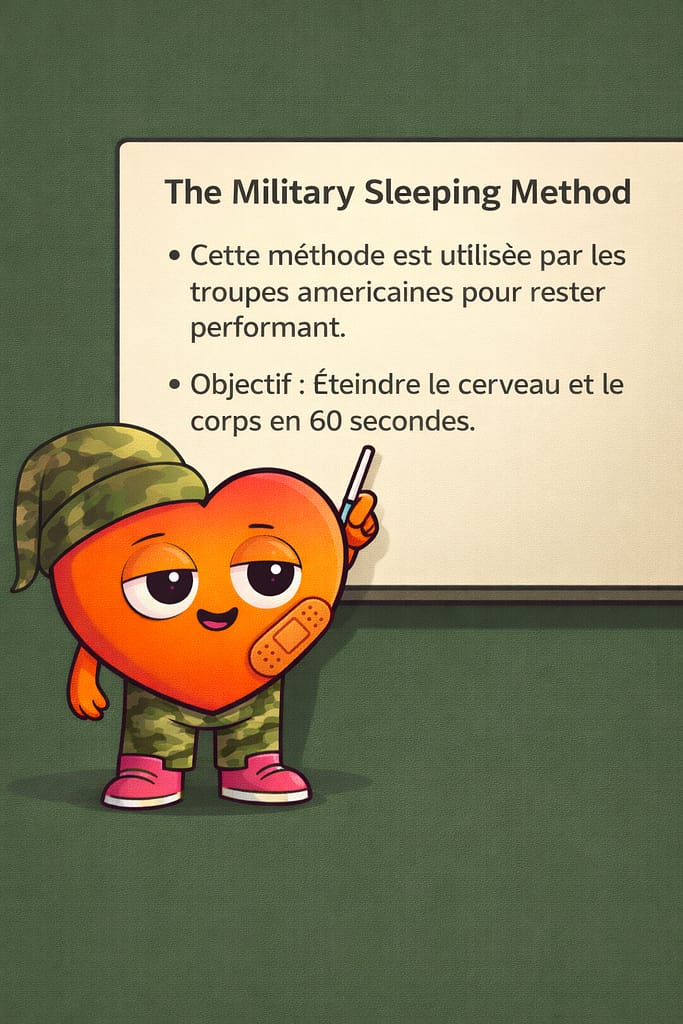
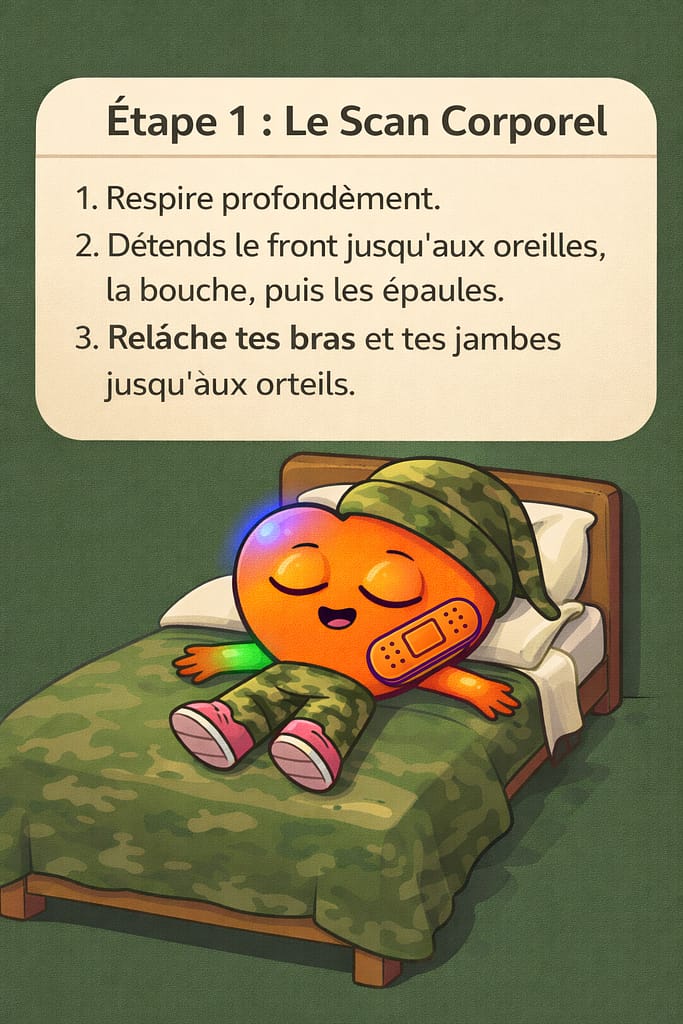
There’s a technique developed during the Second World War for American pilots — documented by Lloyd “Bud” Winter in his book Relax and Win (1981). It combines progressive muscle relaxation with mental visualization. After six weeks of practice, 96% of soldiers fell asleep in one minute, even with gunfire in the background.
In France, the IRBA — Institut de Recherche Biomédicale des Armées — also actively works on these techniques for military personnel. Which tells you this method is taken very seriously.
We walk you through exactly how to do it — step by step — in the carousel just below.
What now?
We hope the military method will have sorted out your night and that you’ll wake up feeling less tired. In the next article, we’ll dig deeper into the link between sleep and emotional fatigue, and what you can do to tackle it.
Feel free to share your own tips for getting back to sleep in the comments. And if you want to test Emosupport, you can join the waiting list. No spam — just a message when it’s ready.
FAQ — Sleep & Emotions
It’s because your brain loves habits, even the ones that don’t do you any favours. If you go to bed with lingering tensions or unresolved thoughts, it can “reopen the file” at an hour that keeps coming back. And the more you notice that wake-up, the more your brain anticipates it. Logical — and yes, annoying.
Yes, absolutely. When you’re sleep-deprived, everything becomes more intense: the smallest remark stings more, the smallest friction drains you more, and putting things in perspective takes enormous effort. Yet this isn’t “you overreacting.” It’s simply that your mental energy is lower — so managing emotions becomes more costly.
It depends on what you feel. If you sense you’re going round in circles, getting up for 2–3 minutes can help — no bright light, no screen. Just enough to break the rumination mode and come back to bed more calmly. On the other hand, if you feel you can drift back down lying down, stay. The idea isn’t to follow a perfect rule: it’s to find the shortest path back to rest.
In the moment, it won’t fix your night. But over time, it changes everything: you start spotting patterns — the days that end in late-night wake-ups, the emotions that keep coming back, the recurring hours. And when you understand your triggers, you can adjust earlier, with small and realistic actions, without putting pressure on yourself.
It’s not just about the light. It’s mainly because they put you straight back into “info + decisions + emotions” mode. One scroll and your brain switches back to action mode. At 2am, you don’t need content. You need to come back down.
This recurring wake-up is often connected to what you experienced during the day. When strong emotions — stress, anxiety, frustration — haven’t been released before bed, your brain keeps processing them through the night. And it’s precisely between 3am and 5am that your sleep becomes lighter, making you more vulnerable to thoughts that resurface. It’s not a problem in itself: it’s your brain telling you it still has work to do. Writing down what you feel when you wake up can help you spot patterns and better understand what’s going on emotionally.
It depends on what you’re feeling. If your thoughts are spiralling, getting up for two or three minutes can help — no bright lights, no screens. Just enough to break the rumination loop before heading back to bed more calmly. If you feel like you can drift back to sleep lying down, stay put. The goal isn’t to follow a perfect rule: it’s to find the shortest path back to calm.
In the moment, it won’t fix your night. But over time, it changes everything. You start spotting patterns — the days that end in late-night wake-ups, the emotions that keep coming back, the recurring hours. When you understand your triggers, you can adjust earlier, with small and realistic actions, without putting pressure on yourself. And if you talk to a professional, you arrive with concrete observations — not just vague impressions. That’s a completely different conversation.