
You’re probably thinking: “What’s this about… emotional motivation?” Some fancy way to dress up mood tracking? Nope. Promise.
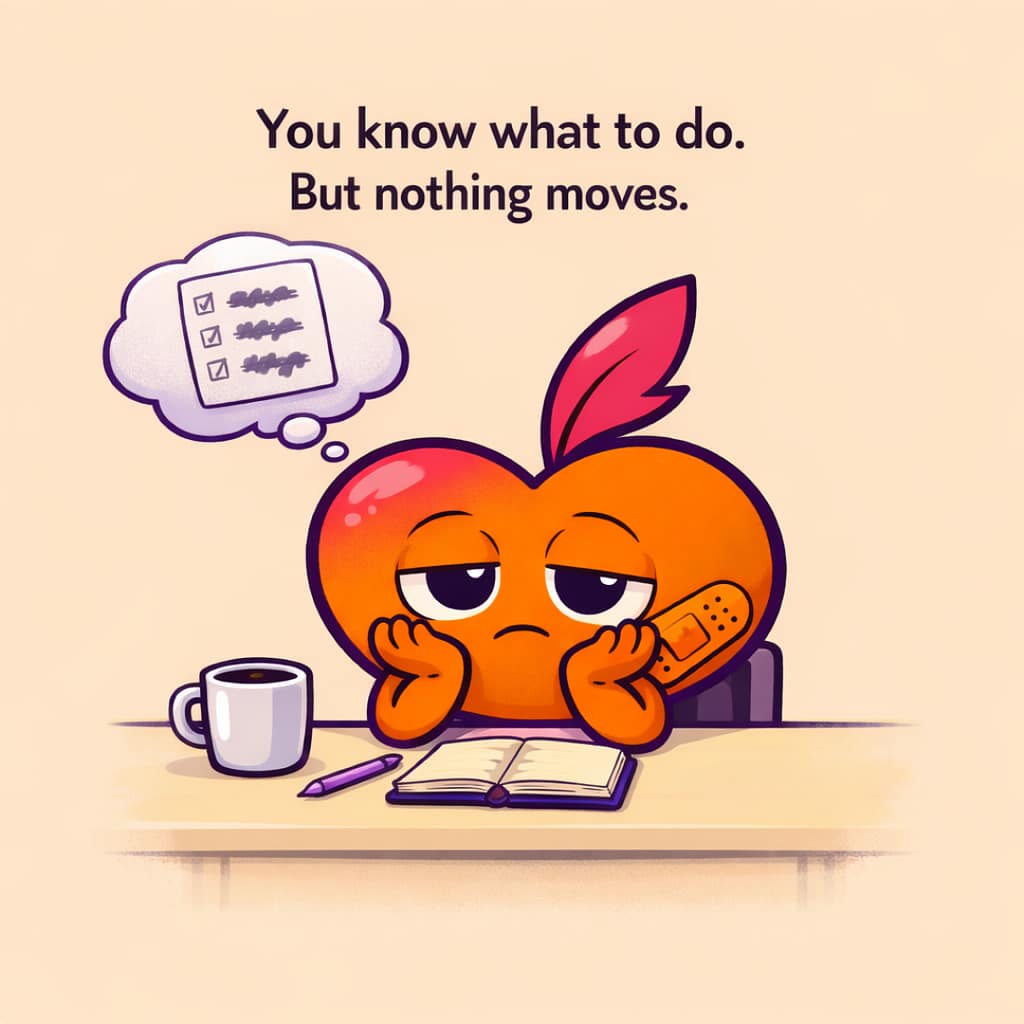
You know that moment when you know exactly what to do… but you have zero desire, zero energy? And then other days, you crush your to-do list in ninja mode without really understanding why. That’s where emotional motivation comes in.
The idea is simple: your emotions set you in motion — they motivate you. If you observe them in context, you can act a little better, at the right time.
So what exactly is emotional motivation?
In psychology literature, the concept is called emotional motivation.
Most definitions converge around this:
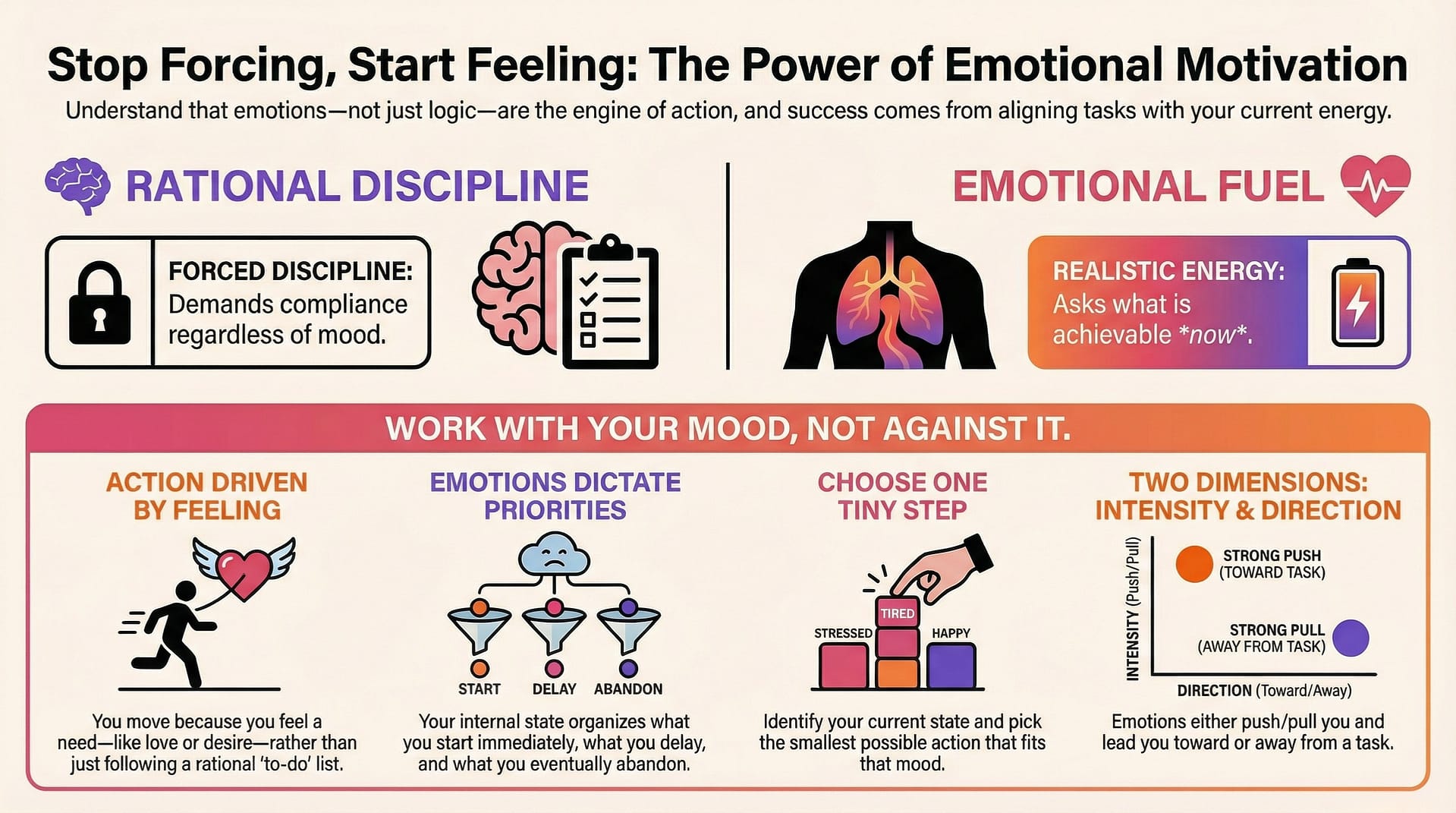
Emotional motivation is the desire to act that comes from your emotions: you take action because you feel something — desire, fear, love, anger… — not just because you “should.”
Research shows that emotions guide our actions based on our emotional needs: pleasant emotions strengthen engagement, while unpleasant ones can slow us down or redirect our behavior.
More recent work in neuroscience and motivational psychology also shows that emotions have a motivational dimension:
- Intensity: how strongly you feel pushed or held back
- Direction: you move toward something (approach) or you pull away (avoidance)
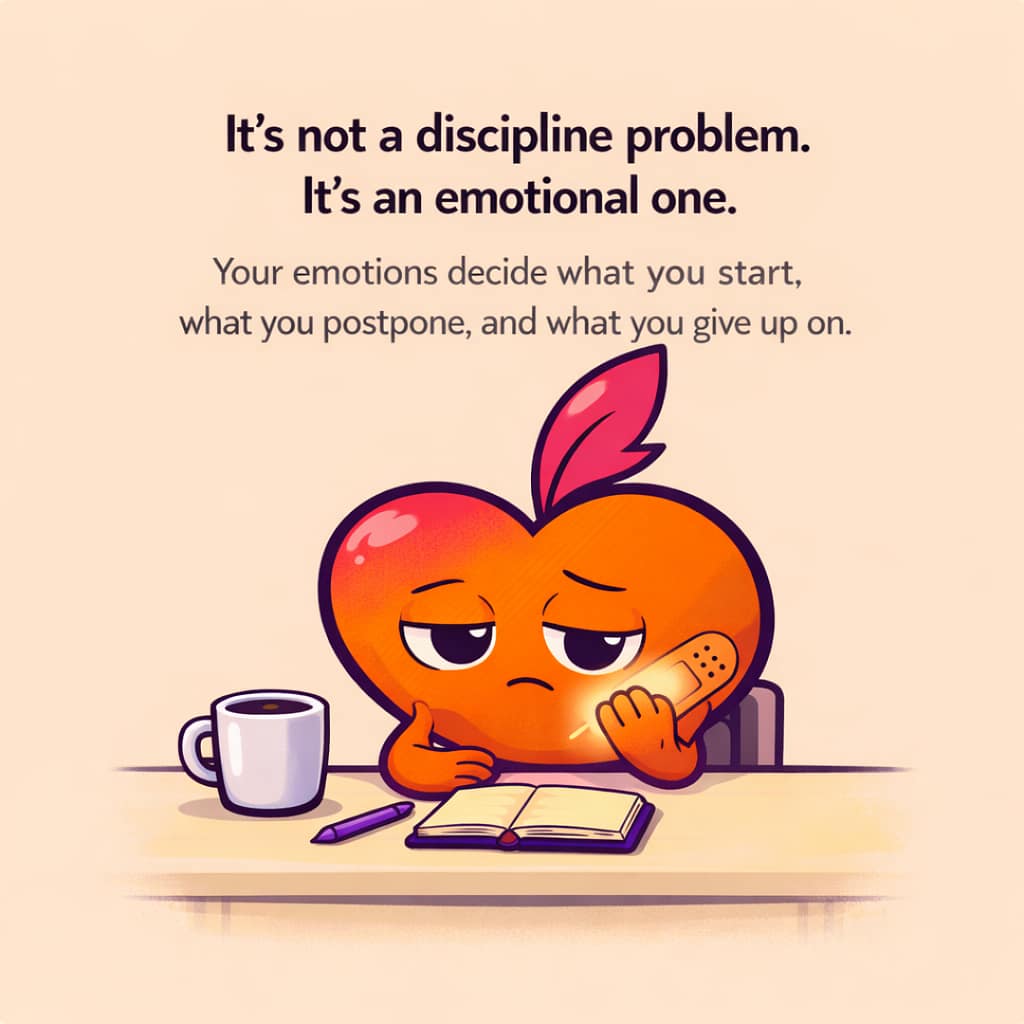
In short: your emotions aren’t just sitting there in the background. They organize your priorities — what you start, what you postpone, and what you give up on.




Emotional motivation vs. “rational” motivation
You’ve probably been sold motivation as something very mental:
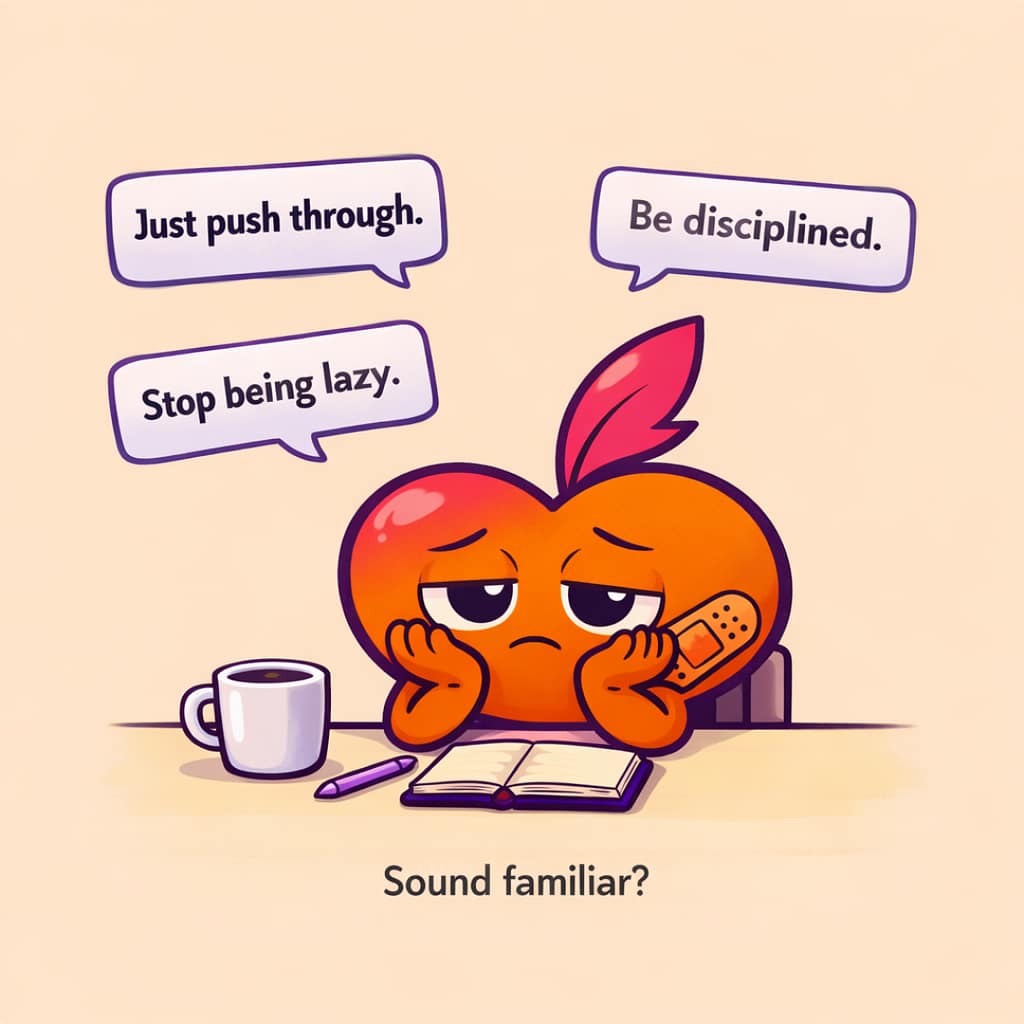
“All it takes is discipline.”
“Where there’s a will, there’s a way.”
“You just have to push through.”
“Make a plan and stick to it.”
That’s rational motivation: based on your logical goals, the “I have to”s, the “I should”s.
Emotional motivation asks a different question: “What am I actually feeling right now… and what does that make me want to do, on a small scale?”
Research on motivation already distinguishes between intrinsic motivation (I do something because it matters to me) and extrinsic motivation (I do it for a reward or to avoid punishment).
Emotional motivation is the sensitive layer of intrinsic motivation: you move forward because something inside you is touched — values, needs, wounds, hopes — not just because it’s “reasonable.”
How your emotions sabotage (or fuel) your motivation
Let’s look at a few emotions from your daily life:
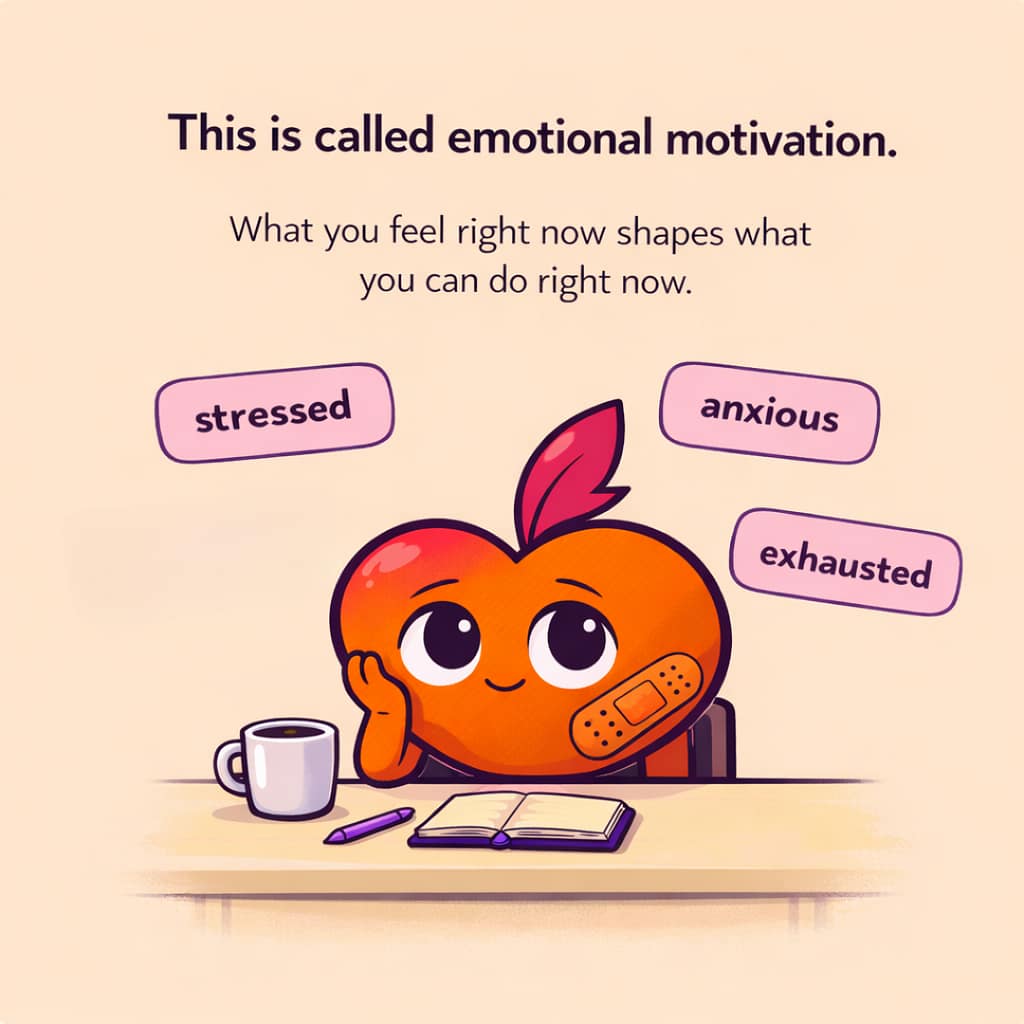
Stressed: your brain switches to survival mode → you focus on the most urgent problem and push everything else aside.
Anxious: you imagine the worst-case scenarios → your motivation turns into avoidance (“if I don’t start, I can’t fail”).
Emotionally exhausted: your inner battery is drained → even the tiniest tasks feel heavy.
Happy or in love: you feel carried → you take initiative more easily.
Self-love: you talk to yourself with kindness → you dare to do things that aren’t perfect, but that are done for you.
Emotional motivation is not “waiting to be in a good mood before you act.” It’s identifying what state you’re in… and finding the most appropriate, most realistic action from that state.
It’s the energy that comes from what you feel — pleasant or not — and points you toward one small, useful action: writing two lines, taking a breath, resetting, going to bed earlier.
Observing your emotions is not judging yourself. It’s taking a quick snapshot of how you’re doing right now, then deciding on one small, realistic step. What’s the point? To avoid running on autopilot: you see the low-energy days coming, you spot the same triggers, and you choose your daily actions more wisely.
And where does Emosupport fit in?
Everything we just covered — starting from what you feel, respecting your energy, moving forward in small steps — that’s exactly what Emosupport, the emotional motivation mobile app tries to turn into an everyday tool.
The idea is simple: you do a quick check-in. In a few seconds, you note your mood, your emotions, and the quality of your sleep. No endless questionnaire, no judgment. Just you, right here, right now.
From there, the app offers you a motivation that matches your actual energy level. A short message — kind, realistic — not a lecture, not an endless to-do list. The goal is to help you spot the next doable step for today. Not 40 tasks. Just the next one, at your own pace.
The difference with a regular to-do list? You stop fighting your mood. You start from your real state — not from what you “should” be feeling. And even on the tough days, just naming what you feel and acknowledging your energy helps you see things more clearly. The rest can wait.
In a nutshell, Emosupport is a copilot: it adapts to your mood, your emotions, and your sleep, and it offers you short, doable steps to keep going. You don’t need to be “at your best” to move one step forward.
Curious? Sign up for the waitlist to try the app and do your first check-in — it takes 30 seconds. And tell me in the comments: what’s the emotion that blocks you the most? If you’ve missed any previous episode, you can always catch up by checking out the other posts.
FAQ — Emotional Motivation
It’s the drive that comes from what you actually feel — not from what you «should» do. You take action because an emotion is pushing you (desire, fear, love, anger), not because it’s written in your calendar that it’s time to.
Regular motivation is «I have a goal, I stick to it.» Emotional motivation is «given how I feel right now, what action is actually possible for me?» It starts from your real energy, not the ideal version of it.
Yes — and it’s physiological, not a willpower issue. When you’re stressed, your brain prioritizes survival. When you’re anxious, you avoid things to protect yourself. When you’re emotionally exhausted, even small tasks feel heavy. That’s not a character flaw.
Not by forcing yourself. By first identifying where you’re at — then choosing the most realistic action from that state. Two lines in a journal, five minutes to breathe, going to bed earlier: that’s emotional motivation in practice.
It helps you do that quick check-in — mood, emotions, sleep — without a lengthy questionnaire. The app adapts to your real state and suggests one doable step for today. Not a 40-task to-do list. Just the next one, at your own pace.