
An epistolary novel has something the others don’t. It catches you off guard. You open a book, start reading, and a few pages in you realize you’re no longer quite a reader. You’ve become a confidant, a witness — maybe even an accomplice.
Once you’ve had a taste of it, you never read quite the same way again. Let me tell you about my favourite format: the epistolary novel. And yes, it’s another excuse to talk about letters.
The epistolary novel: a simple definition
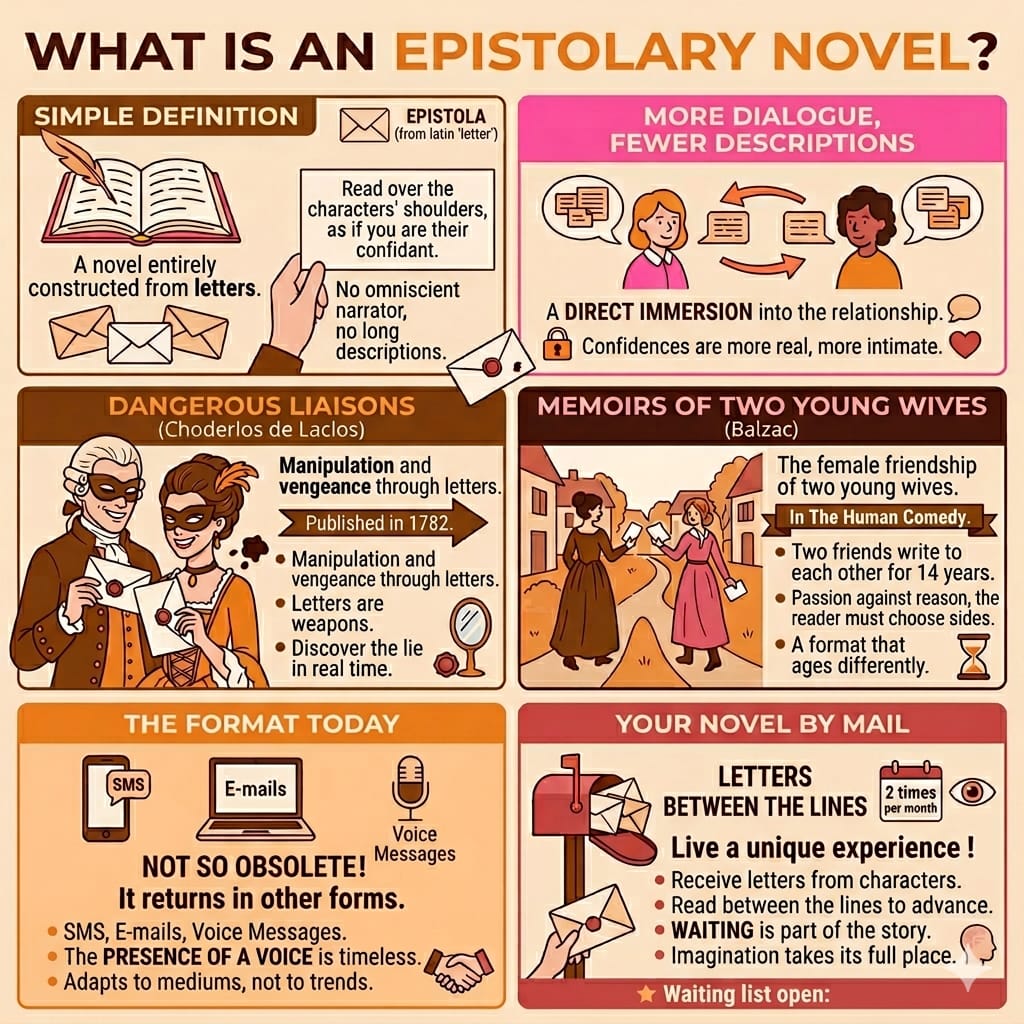
An epistolary novel is a novel built entirely from letters. There’s no omniscient narrator telling you what to think. The long voiceover descriptions are mostly gone. All that’s left is characters writing to each other — and you, reading over their shoulder.
The word comes from the Latin epistola, meaning letter. The genre has existed since the 17th century, and far from feeling outdated, it only seems more relevant.
What actually changes in an epistolary novel
In an epistolary novel, you’re thrown straight into the conversation. From the very first letter, you’re in the thick of it — in the relationship, in the story.
There are fewer descriptions, more exchanges. Less staging, more confiding. Paradoxically, this economy of means makes the characters feel more alive, more immediate, more real. You’re not observing them from a distance. You know them the way you know someone whose letters you’ve read. You’re reading over their shoulder.
That’s what makes this format feel contemporary — even when it was written two centuries ago.
Dangerous Liaisons: the most famous epistolary novel
It’s hard to talk about the epistolary novel without starting here. Dangerous Liaisons by Pierre Choderlos de Laclos, published in 1782, is probably the most read, most adapted and most studied epistolary novel in French literature.
You might know the story: two libertine aristocrats, the Vicomte de Valmont and the Marquise de Merteuil, write to each other to orchestrate their conquests and vengeances. Their letters are weapons. Every word is calculated. Every confidence is a trap.
What’s fascinating is that the epistolary format becomes the perfect narrative tool to tell a story about manipulation. You read both sides. You know what Valmont writes to Merteuil and what he writes to his victims. You see the gap. You see the lies and the manipulation happening in real time.
Memoirs of Two Young Wives: Balzac and female friendship
It’s the only epistolary novel in the entire Comédie Humaine — Balzac’s monumental work, spanning over 90 novels and 2,000 characters, painting a portrait of 19th-century French society.
Memoirs of Two Young Wives struck me for a simple reason: I didn’t get bored. For someone who had sometimes struggled through the length of La Peau de Chagrin or Père Goriot, that was a surprise.
Two friends, Louise and Renée, leave the convent and take opposite paths. One pursues passion at any cost. The other builds her life with method and reason. They write to each other for fourteen years. They share everything — their joys, their doubts, their disappointments. And you, as a reader, feel like you have to pick a side… Balzac himself admitted it: “I would rather be killed by Louise than live a long life with Renée.” But really, you don’t have to choose. You can recognise yourself in both, in one way or another.
That’s what an epistolary novel is: it’s alive, and it ages differently.
What I love about epistolary writing and what it taught me
First and foremost, I write letters, and all my thoughts in my journals. As a reader, I’m a Sunday kind of reader. What I love in books is entertainment. Conversations. Exchanges. Characters who talk honestly, who search and who respond to each other. I’m less fond of long descriptions that set a scene for twenty pages.
It’s not that descriptions are useless — they’re necessary. You have to set context, give the story some flesh. But there’s a balance. The epistolary novel finds it naturally, because a letter is by nature direct. You don’t write to a friend a detailed description of your living room. You tell them what’s happening in it. What you feel. What you can’t quite say any other way.
Epistolary writing suits me because of that. It’s closer to what I’ve always done: writing letters, telling stories to someone. Not to an abstract reader — to a person.
Maybe that’s why The Letters Between the Lines took this shape.
The epistolary novel today: not as outdated as you’d think
You might think the genre has aged. That letters are the past. That nobody writes by hand or waits for the postman anymore.
And yet. The epistolary format is making a comeback, in new shapes — novels told through texts, emails, even transcribed voice messages. The structure stays the same: voices exchanging, and a reader intercepting them.
What touches us in a letter — real or fictional — doesn’t change. It’s the presence of a voice. Someone speaking to someone else, and you in the middle, listening.
The epistolary novel isn’t a dying genre. It’s a timeless one. It adapts to the medium, not to the trend.
Can you write an epistolary novel today?
Yes. And it might actually be more accessible than a traditional novel, precisely because the constraints are different.
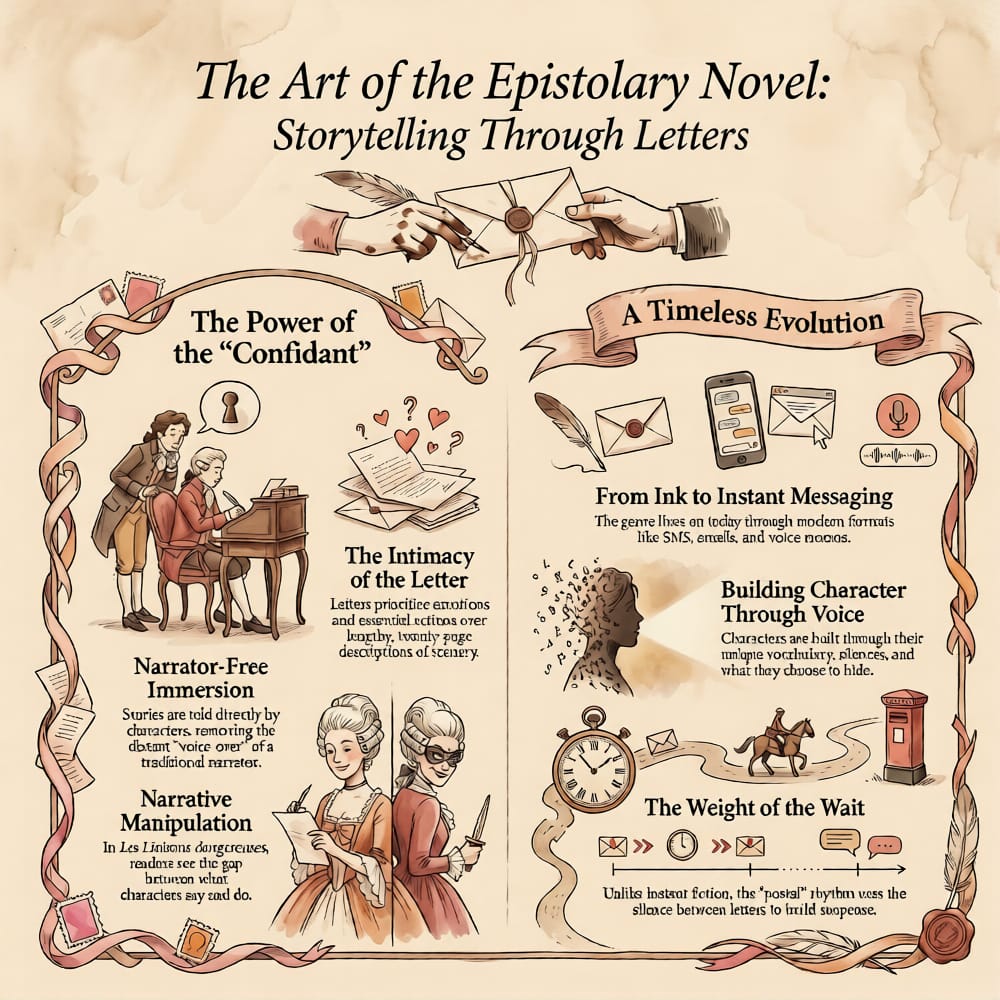
You don’t have to see everything. You don’t have to know everything. You choose a voice — or several — and you write from the inside. What the character knows, what they’re hiding, what they believe. The reader fills in the rest.
Two characters can’t write in the same way, or the novel falls apart. Each letter reveals the psychology of the person writing it: their vocabulary, their silences, what they choose to leave out. Characters build themselves through their words — not through a narrator’s eyes.
The Letters Between the Lines: an epistolary novel you receive by post
With The Letters Between the Lines, you don’t read an epistolary novel. You receive a mysterious envelope twice a month and step into a world. Letters from characters who write to you directly, confide things, leave clues. You have to read between the lines to follow the story.
The wait is part of it. Just as it was part of Louise and Renée’s correspondence. Just as it was part of Valmont’s letters. Just as it’s always been part of my exchanges with my own pen pal.
The wait leaves room for imagination. It builds the desire to reconnect with that unique object: the letter — which says little, but tells so much at the same time.
If you’d like to discover more about the Snail Mail Club and join The Letters Between The Lines experience, the waitlist is open.
FAQ — The Epistolary Novel
An epistolary text is a text written in the form of a letter or an exchange of letters. It can be real (correspondence between two people) or fictional (an epistolary novel, where the letters are invented by the author). Epistolary texts have their own codes: an opening formula, a personal tone, a signature.
A fictional epistolary letter must sound true. It addresses someone specific, it starts from a specific moment, and it has a recognisable voice. The author needs to step into the skin of the character writing — their vocabulary, their silences, what they choose to say or leave out. It’s an exercise in point of view as much as in writing.
An epistolary relationship is a relationship maintained through an exchange of letters. It has its own rhythm — the waiting, the replying, the rereading. It implies a particular kind of intimacy: you write things in a letter that you wouldn’t necessarily say out loud.
Epistolary comes from the Latin epistola, meaning letter. The adjective describes everything related to letters: an epistolary novel, an epistolary art, an epistolary correspondence. In everyday language, it’s mainly used to refer to the literary genre built from exchanges of letters.