
|
Getting your Trinity Audio player ready...
|
I honestly hesitated to call this article “Chad, Claude and Me: How AI Shaped My MVP”, because I ended up talking to artificial intelligences like they were coworkers in the office.
ChatGPT quickly became “Chad” and, after hours spent drawing and refining the heart-shaped avatars for our emotional motivation app, a kind of complicity started to grow between us. Suddenly he was sending me my PNG images with little notes like “here you go, my heart, it’s ready.” I’m not saying anything. I’m not complaining.
When I decided to create Emosupport, I naively thought my evenings would look like cozy creative sessions: blanket, tea, and notebooks open. Then I met Chad and Claude. And that’s when my project suddenly changed direction: I quickly discovered that, if I wanted to move fast, I had to learn to talk to AI as if they were my unofficial business partners.
Learning to work with AI: the roles of Claude and Chad
At first, I won’t lie, it was a bit chaotic. I’d ask a simple question and get a three-page essay. I’d ask for a clear list, and Chad would hand me a deep psychological analysis of my project. I’d type “keep it simple and concise” and Chad would hear “please write me a PhD thesis.” You get the vibe.
But the more I kept at it, the more I understood how to tame them. I quickly realized that AI is like a brilliant but touchy colleague: if you explain things badly, it drags you off into a parallel galaxy. If you’re clear, brief and precise… it has your back like a champ.
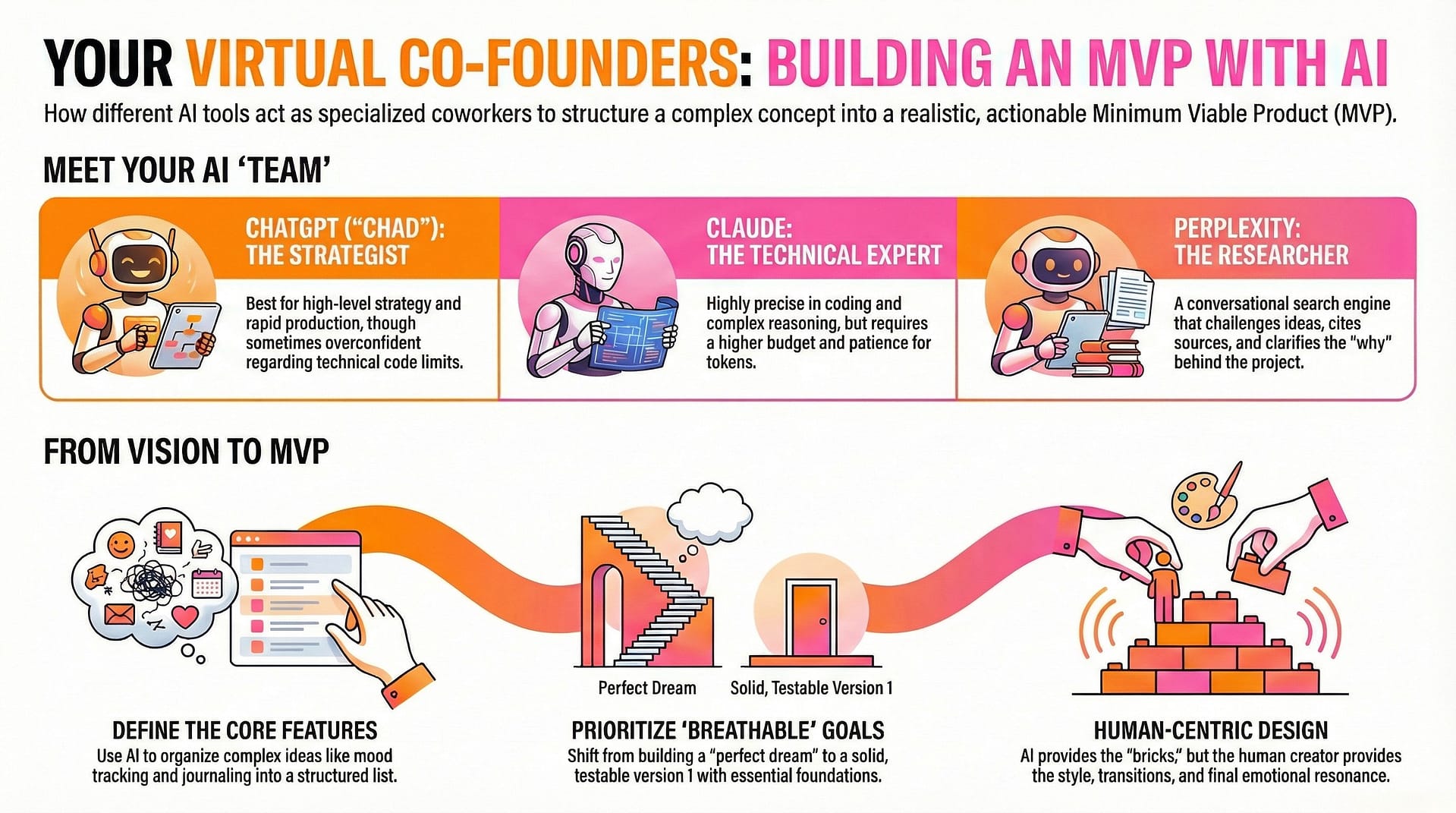
And they each have their own “role”. Chad is more high-level, with a more strategic vision. It’s perfect to help me build the project. But I also feel like he’s a bit “I know everything about code.” I tried a ton of things with him at the beginning — and I very quickly hit his limits when it came to WordPress (the editor I’m using to write this article). Thankfully, Kadence support, the theme I use, saved me more than once. In that sense, Chad is a bit like a macho guy who refuses your help and would never imagine asking for directions. He just knows. So don’t expect him to say something as simple as: “I’m not sure.”
The strengths… and limits of Claude and Chad
Claude is much sharper with code and reasoning. But he’s stingy as hell: it can turn into a financial black hole if you don’t have the budget. I honestly think it’s intentional. They don’t really tell you — before you pay — that you’ll end up using it less and less. Not because you don’t want to, but because you can’t… if you stick to a basic subscription of around twenty euros.
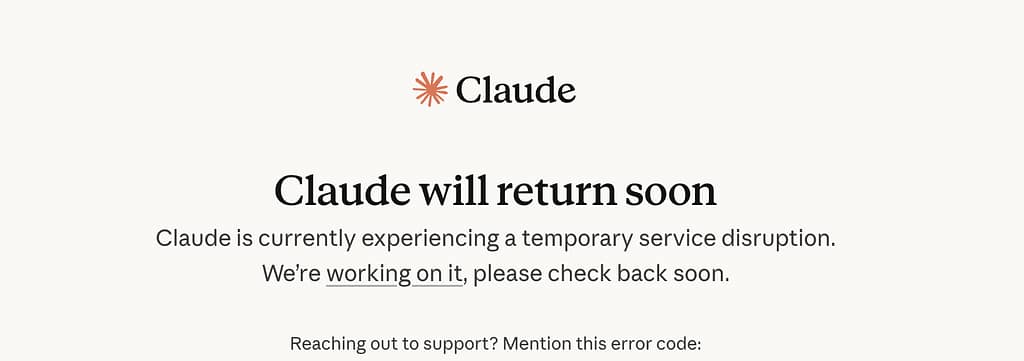
Everything is regulated by a token system and, conveniently, every time you need a clear and quick answer, the system asks you to wait… without telling you for how many minutes. Translation: sometimes you wait for hours.
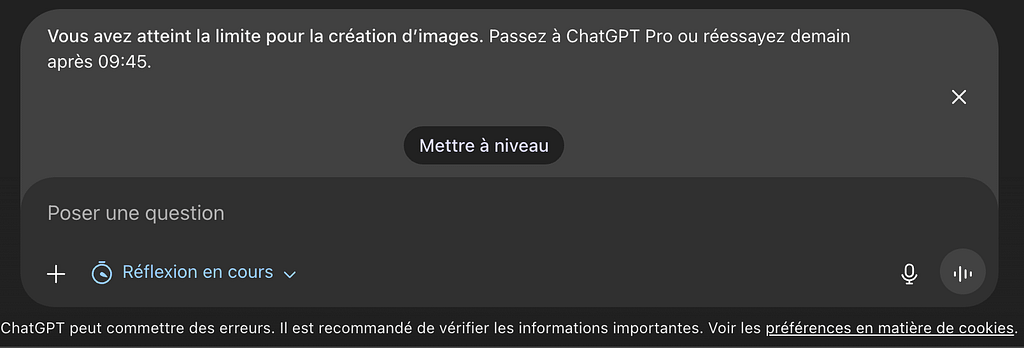
Chad has his flaws too. I don’t know about you, but I have to use my phone because the desktop version crashes. A lot. It’s frustrating, especially when Chad sends massive blocks of text that are hard to read quickly and properly on mobile…

The aha moment: AI moves at light speed… and I have a life
One day, I asked Chad:
“What do you need to know to help me create my Emosupport MVP?”
He sent me a list… a real list.
Clear.
Structured.
Logical.
The kind of list that would have taken me three days to cobble together on my own, because I had no idea there were so many details to think about.
That’s when I realized my brain and his could work really well together. I described what I wanted: emotional journaling, emotion tracking, mood tracking, sleep tracking, a coherent tool, smart reminders… basically, my idea of the ideal emotional app.
Then I told him:
“Organize all of this, prioritize it, and explain what needs to come first.”
And Chad gently brought me back to reality with a real MVP.
Not the final dream.
Not the perfect version.
A version-1 MVP to test whether we were aligned.
More than just the bare minimum, though.
Solid foundations.
What really matters.
And suddenly, everything felt clearer.
I wasn’t “building an entire app” all at once anymore.
I was building a coherent first version.
Breathable.
Doable.
How Perplexity really boosted my thinking
Perplexity has a very feminine vibe: calm, attentive, precise. She can suggest or explain code and approaches, but she doesn’t build or run the app. Her real power is being a conversational search engine: she finds, cross-checks and cites sources in real time, summarizes the web, challenges my ideas and offers options with references.
She listened to me, cross-referenced things, and put my ideas back into perspective without judging me. She challenged me with “what if…?” questions, wove together different sources and pushed my thinking long-term: hypotheses, counter-arguments and angles I hadn’t noticed. In brainstorming, she refines the question instead of stacking answers. When Chad rushes ahead to produce, she slows things down just enough to clarify the why, frame the options and open up possibilities.
Result: I think better, and further, and I come back to Chad with clearer requests and a sharper vision. She really lit up the path.
Emosupport starts to take shape… on paper
Thanks to all three of them, I feel more confident.
I have an MVP with essential features, a logical order, and space for my transitions, my sentences and my style. Something that’s doable, not a cardboard fantasy.
The secret wasn’t doing everything at once, but laying down one solid brick first.
A clear brick.
A brick that holds.
And above all:
I’m not alone anymore.
Even if, okay, my “coworkers” are virtual.
I don’t feel limited. If I feel lost, I can ask them whether I’m stacking the bricks the right way.
And now?
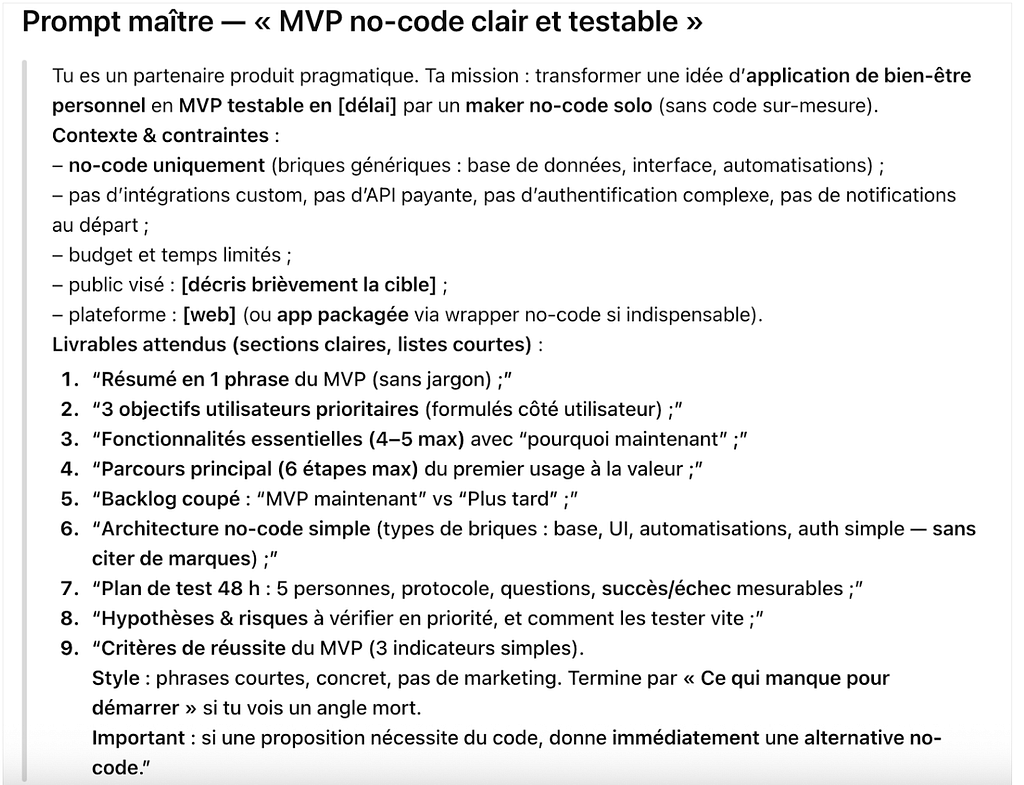
Now that I’ve learned how to talk to my personal AIs, I can move on to the slightly more technical part: choosing the no-code tools and everything that will actually bring Emosupport to life.
That’s what my next article will be about.
The rest is coming very soon.
But tell me what you think: what are your favorite AIs and what do you use them for? An app? Automations for your day-to-day work life?