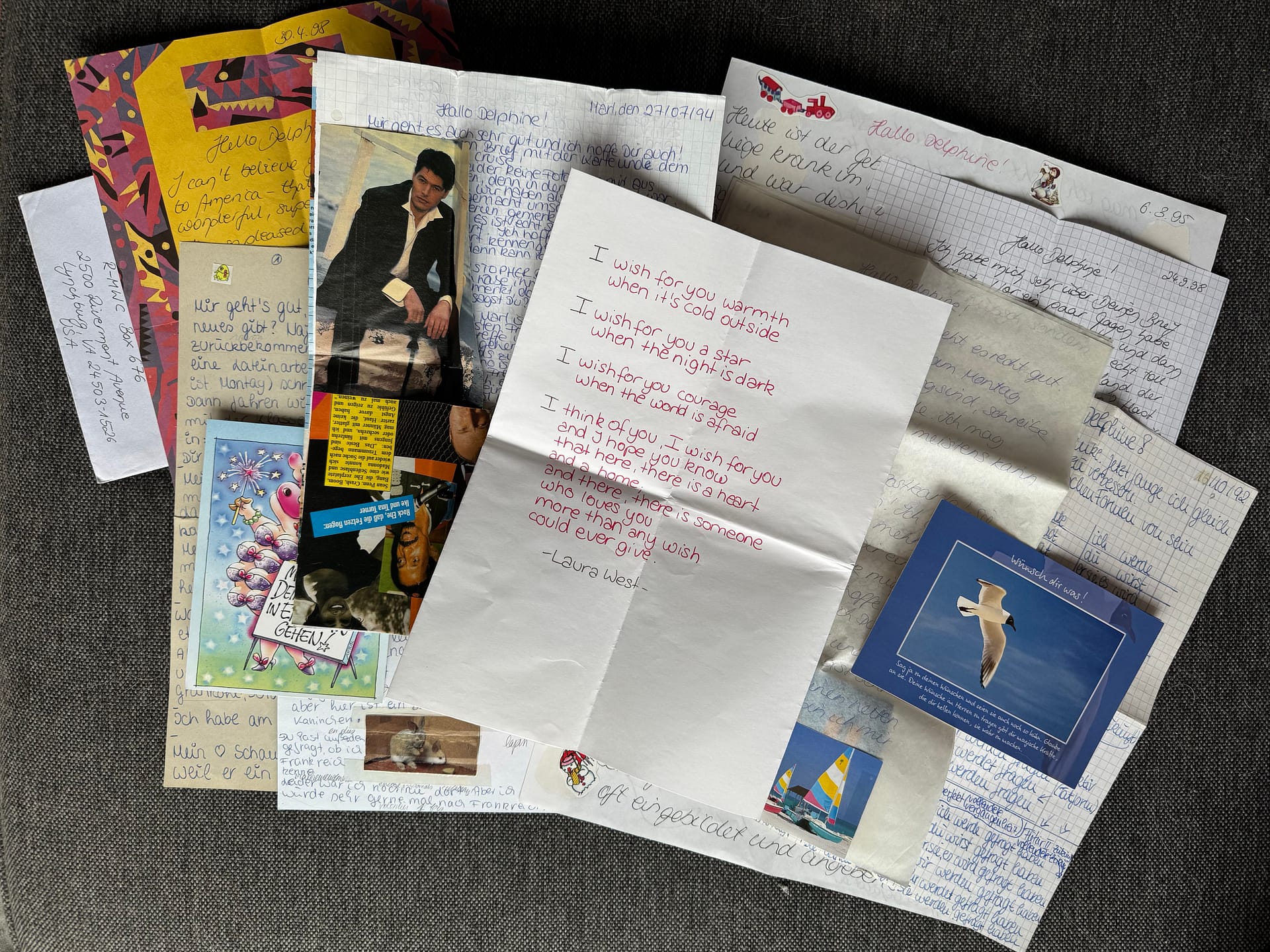
Most of my pen pal letters, I threw them away a few years ago. They were taking up too much space in my drawers. I must have had more than a thousand of them.
Through an international pen pal exchange organization, I was connected with correspondents from all over the world starting at the age of twelve. Boys and girls who loved to write and lived everywhere: in London, New York, or even Orléans.
A few letters and then they fade. But the one I’m still in touch with today is my German pen pal, Jennifer. With her, I’ve shared secrets and moments of life. She quickly became a friend I love to see again whenever she visits, I visit her, or when our travels bring us together.
In this article, I’ll tell you what a lifetime of pen pal letters has taught me.
What my pen pals taught me over the years
The chance to broaden my horizons, spark new encounters, and discover new stories—that’s what drew me to paper correspondence.
Our names were exchanged at random from an Excel list. That’s how my pen pal and I, each on our own side, came to discover the other existed. We started writing to each other when we were 12, and we’re still at it today. Our letters used to be very regular—about every two or three weeks—but we write by post less often now. WhatsApp has taken over. Even so, we still read each other’s news with great pleasure.
What do all those letters have in common? The joy of finding them in the mailbox, the impatience to open them, to read the news and soak in all the care they carry. They are messages of a sincere friendship woven together over years of reading.
Writing a letter by hand means giving time and meaning to something you’re offering to someone. You choose your stationery with care, and a matching envelope or not. You pick a stamp at the local post office. You select your pen with passion, knowing the ink can’t bleed through to the other side. You often take time to draft a first version so you won’t have too many crossings-out on your colored paper.
When we were children, we’d send each other excerpts from our favorite magazines. We’d personalize them with markers, stickers, and whatever else came to mind. Even correction fluid could have style on our letters.
Handwriting means offering your time
That’s what brings pleasure and makes you smile : the attention paid to small details. You take the time to choose your words, your phrasing. Grammar, spelling, even your handwriting get examined carefully to let your personality shine through.
There’s an intimate need to make the reading experience beautiful—visually and sensorially. You want the letter to be worth looking at before it’s even read. You keep your correspondent in mind the entire time you’re writing, and still afterwards, when you picture them holding your envelope in their hands.
Waiting is also part of the process. Not the anxious wait of notifications. The active wait for something precious because your letter takes time to arrive. Sometimes the wait lives in rereading too. Words and little gestures say things to you much later, long after you’ve first read them, when you least expect it.
Exchanging letters with someone means sharing chosen moments of life and bringing them back to life. It means including the other person in your world. It’s a feeling of comfort you share through these handwritten letters.
Why a pen pal letter does what an email cannot
Everything I’ve just shared—that’s exactly what an email can’t instill: emotion. A computer or phone helps you write it. An email can feel cold at first. It looks perfect thanks to spell-checkers. But it’s perfectly impersonal, even more so when it’s written for you by artificial intelligence. It’s better suited to professional exchanges, with your lawyer or your doctor.
An email from a friend is never the prose of your favorite writer. It’s an extra burden passed on to you. A demanding read that you end up skimming through quickly.
It’s not that email is worse. It’s that it doesn’t have the same function. An email informs and instructs. A letter presents, warms the heart, reassures, makes you smile for no reason, and leaves you impatient for the next one. The attachment is entirely different. One you reread with nostalgia, the other disappears as quickly as it arrived. It comes, you read it, you reply or you don’t. The letter captures you, holds you, marks you. You take tremendous care to respond precisely to each of the arguments it holds.
A letter stays. An email disappears.
There’s also something an email can’t carry: the physical trace. A pen pal letter has a smell. A texture. It was touched by someone who was thinking of you. You can reread it in ten years. You can fold it and keep it in an envelope, at the back of a drawer. It doesn’t vanish in a server outage.
An email ages quickly, while a letter is genuinely timeless. I’ve reread exchanges from two decades ago with pleasure. Reading certain details took me straight back to what I was feeling then. Rereading a paragraph you’d never write the same way today shows you how time has passed. Emails are effective and short, sharp. They don’t leave as much room for life.
You don’t capture intonations, hesitations, or moods the way you can when you contemplate someone’s handwriting. Handwriting truly speaks to us, while email is designed to stay neutral, without affect. A letter becomes the last precious link you have to those you’ve loved. When death takes them from you, only their letters and their photographs can console you.
The benefits of pen pal letters
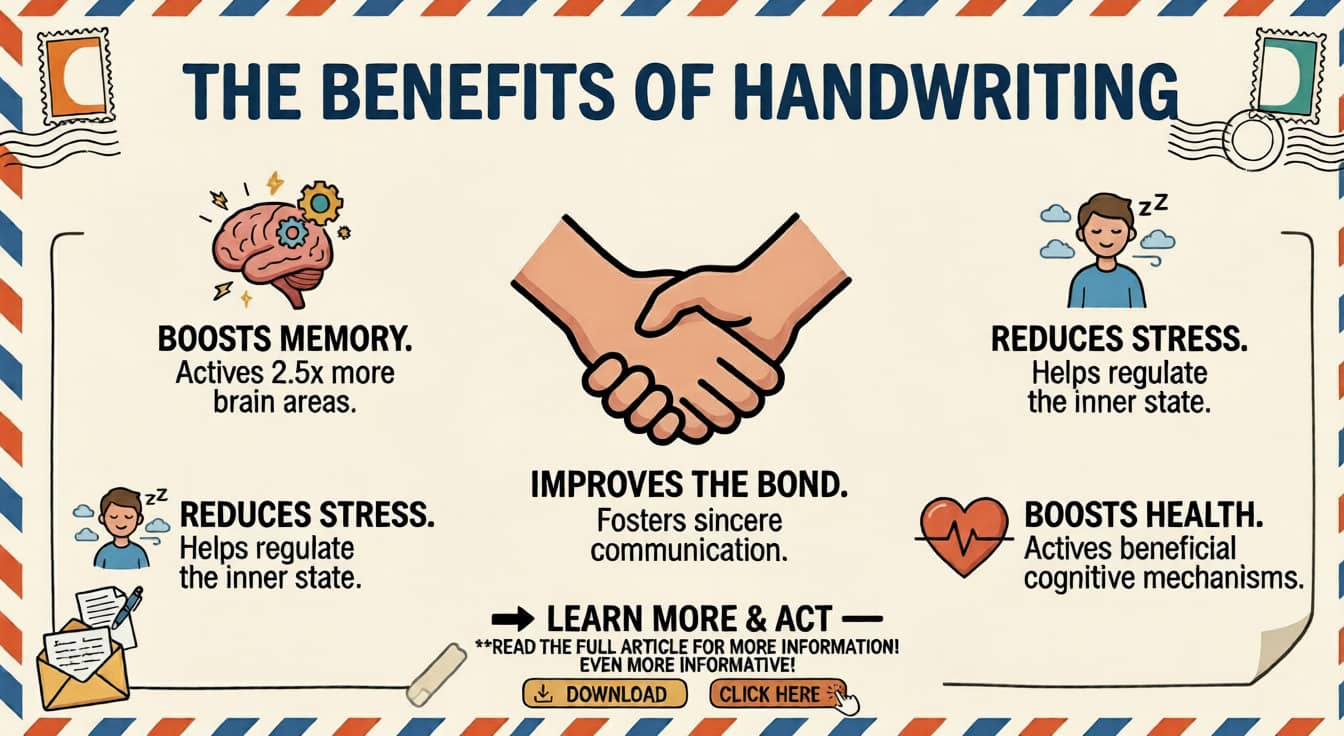
I wrote for a long time without knowing that science would one day confirm what I’d always felt instinctively. Writing by hand slows thought down. Not to make it less precise, to make it more honest. You choose your words carefully. You start again. You search for how to say what you really mean. Recent research shows that handwriting engages more brain networks than typing, which may support learning and the encoding of information. F. R. Van der Weel and A. L. H. Van der Meer published these findings in 2024 in Frontiers in Psychology. What you write by hand, you integrate differently.
Several studies suggest that expressive writing can help process difficult emotions and reduce some of the effects of stress. Karen Baikie and Kay Wilhelm summarised these benefits in a 2005 review published in Advances in Psychiatric Treatment. You don’t even need to send the letter. The act of writing your emotions is enough to regulate your inner state. This is what keeping a journal — or journaling — is all about. You confide your thoughts to a notebook that no one else will ever read.
What correspondence changes when it’s for someone else
When you write to someone you know, the effect is even stronger. You put words to what you’re living through. You structure it. You decide what to say and how. It’s a form of expressive writing that even reduces doctor visits by 19% among regular practitioners.
But what paper correspondence offers beyond a simple journal is connection. Reciprocity. Someone on the other side who waits, who replies, who exists in your life in a way that doesn’t go through a screen. A study by Mueller and Oppenheimer (Psychological Science, 2014) established that handwritten notes are retained 25% better than typed ones. The same principle applies to handwritten letters: what you write physically, on paper, stays with you.
The concrete benefits of handwritten correspondence, in short:
- Reduces stress and anxiety through the act of writing itself.
- Strengthens memory and understanding of what we’re experiencing.
- Creates a quality connection, built on intention and time.
- Leaves a physical trace you can reread, keep, and pass on.
- Trains you to choose your words with care—in every form of expression.
It’s not a step back in time. It’s a choice to slow down around what matters now.
What if you wrote your first pen pal letter?
There’s still so much to say about pen pal letters. But the best thing is to start and write to someone you love. Put your thoughts down and choose your words. Take time to enjoy the moment: to choose your materials and perfect the finishing touches. You might be surprised by their response.
The Letters Between the Lines goes even further: you receive letters without having to write any. A story built letter by letter, to piece together. An epistolary UFO.
If you’d like to take part in this unique experience or share it with a friend, don’t hesitate to join the waitlist.
Do you have pen pals? Do you still write to them? Tell me more in the comments. I’ll talk about the connection between letters and the epistolary novel in my next article.
FAQ — The Letters of Correspondance
A letter is an object: a written sheet, sent to someone. Correspondence refers to the exchange itself—the relationship that builds over time through letters.
We talk about letters in the plural to describe a collection. We talk about correspondence to describe the bond between two people who write to each other regularly. A pen pal letter is therefore a letter that exists within this ongoing exchange.
Pen pal letters are letters exchanged regularly between two or more people, generally by post. They differ from a one-off letter because they’re part of a relationship: each letter replies to the previous one, continues a conversation, keeps a connection alive. Paper correspondence has a long literary and intimate history, from the letters of Madame de Sévigné to those of Simone de Beauvoir.
There are no strict rules. A handwritten letter can start with something simple: what you saw this morning, what crossed your mind. What matters is writing to the person, not drafting a perfect piece of text. You ask a question, share an observation, give your news. The rest comes with time.
We generally distinguish between personal correspondence (between friends, family, or lovers), professional correspondence (between colleagues or partners), and literary correspondence (between writers or artists, often published posthumously). There’s also creative or fictional correspondence, like epistolary novels, where characters exchange letters that make up the story itself.